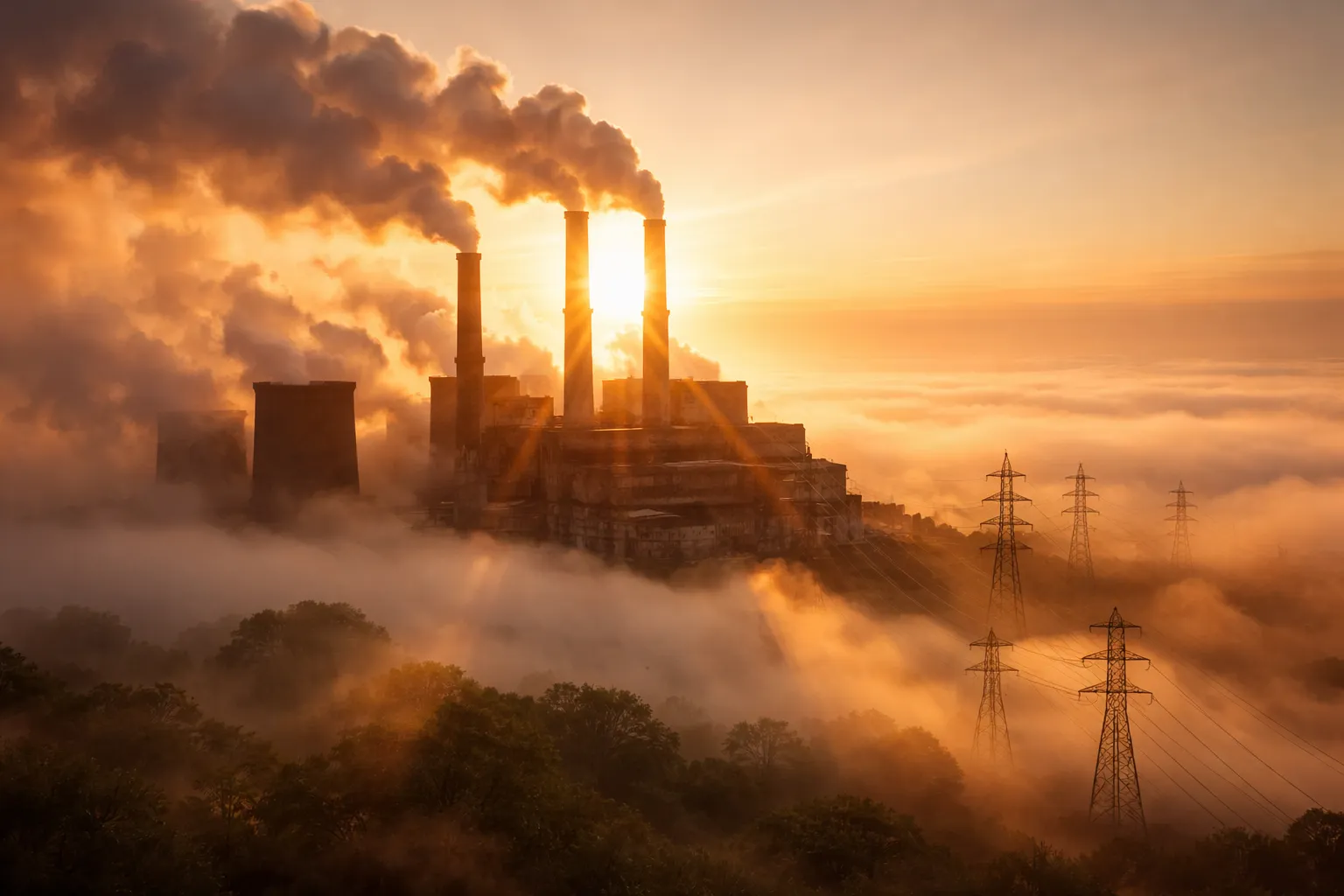
For most of the modern era, coal sat quietly at the centre of the electricity system. It didn’t need much defending because it didn’t have any serious competition. Power stations ran, lights stayed on, and the system barely changed.
That era has now ended.
What’s happened since late 2025 isn’t a policy blip or a short-term market reaction. It’s a structural rearrangement of the global power system, driven by one blunt force: solar became cheaper and faster to deploy than coal, and the numbers stopped working the other way around.
For the first time on record, renewable energy overtook coal as the world’s largest source of electricity during the first half of 2025. Crucially, this happened while demand was still rising. Global electricity use increased by 2.6%, yet solar and wind didn’t just absorb that growth — they exceeded it. Fossil fuel generation fell in absolute terms, not because the world used less power, but because clean energy took more than its share.
That distinction matters. Coal didn’t decline because demand collapsed. It declined because it was outcompeted.
And despite the dire predictions that once accompanied this shift, the sky didn’t fall. Whyalla is still on the map, and I’m yet to see anyone paying a hundred dollars for a Sunday roast. The system kept working.
The Shift That Broke the Old Model
By mid-2025, renewables were supplying 34.3% of global electricity, edging past coal’s 33.1%. On its own, that might sound incremental. In context, it’s fatal to the old model.
Coal has always relied on rising demand to justify its existence. This time demand rose, and coal still lost ground. That’s the inflection point.
Solar did most of the heavy lifting. It delivered 83% of the total increase in global electricity generation and grew by 31% year on year. Its share of the global mix has more than doubled since 2021, and it’s still accelerating.
The practical outcome is something that would have sounded fanciful not long ago: global power sector emissions flattening out even as developing economies continue to industrialise.
Australia’s Unintentional Case Study
If there’s a real-world example of how this transition actually works, Australia is it.
By late 2025, more than 4.26 million Australian households and small businesses had rooftop solar installed. Combined capacity reached around 27.8 gigawatts — more than all remaining black and brown coal stations in the country put together.
This wasn’t driven by better sunshine. Plenty of places have that. It was driven by process.
Australia stripped the friction out of residential solar deployment. Virtual permitting, fast approvals and dense installer networks mean systems can be sold and installed in days rather than months. Costs followed, dropping to around 90 cents per watt on average.
As a result, more than a third of Australian rooftops now have solar. In the United States, it’s still under 10%.
When Bureaucracy Becomes the Cost
The contrast with the US is stark. Hardware prices are similar, but bureaucracy dominates outcomes.
With more than 18,000 separate permitting jurisdictions — many still using paper forms and manual approvals — delays drive up cancellations, marketing costs and installer overheads. By 2025, so-called “soft costs” accounted for nearly 80% of the price of a residential solar system.
The end result was brutal. A typical American household paid around $28,000 for a system that cost roughly $4,000 in Australia.
Policy then made matters worse. In mid-2025, long-standing federal tax credits were terminated, new import restrictions were imposed on solar components, offshore wind leasing was frozen, and approvals on federal land were tightened. The response was immediate: the International Energy Agency halved its forecast for US renewable capacity growth by 2030.
While the rest of the world kept moving, the US became the outlier.
The Sunbelt Moves First
The fastest solar growth now isn’t happening in wealthy countries. It’s happening in the Sunbelt — regions close to the equator that house most of the world’s population and will drive the bulk of future electricity demand.
Pakistan offers a clear example. As grid prices doubled and reliability declined, households and industry moved to solar en masse. By early 2025, solar had become the country’s largest source of electricity, supplying more than a quarter of total generation.
Factories shifted off the grid. Farmers replaced diesel pumps. Decentralised energy quietly rewired the economy from the edges inward.
China remains the engine room. In the first half of 2025 alone, it installed more solar capacity than the rest of the world combined, exporting clean technology at a scale that now reshapes global energy geopolitics.
Why Coal Can’t Compete
Coal’s decline isn’t sentimental. It’s mathematical.
Since the 1970s, the cost of solar has fallen by 99.9%. Researchers have identified more than 80 separate innovations — from silicon processing to cell architecture — that pushed costs down as deployment scaled. Each time global solar capacity doubles, prices drop by roughly 20%.
By mid-2025, wholesale module prices had fallen to around ten US cents per watt. At that point, subsidies stopped mattering. Solar could undercut coal on pure cost alone.
Once that happens, the outcome is locked in.
2026 and the Maturing Grid
As Australia moves into 2026, the conversation is shifting again. Solar alone isn’t the endgame. Integration is.
Home batteries are moving from optional extras to essential infrastructure, driven by expanded rebates and smarter sizing rules. Virtual Power Plants are aggregating thousands of household systems into grid-scale assets, paying homeowners for stabilising the network during peaks.
At the same time, electric vehicles are slipping quietly into the mainstream. Most are charged at home, many directly from rooftop solar. Decisions that used to be separate — power, transport and storage — are converging into a single system.
A Transition That Doesn’t Ask Nicely
The uncomfortable reality for anyone hoping the energy transition might stall is this: once a technology becomes cheaper, faster and easier to deploy than the incumbent, it doesn’t need permission.
Politics can slow it, but it can’t stop it.
Coal isn’t being displaced because people asked politely. It’s being displaced because it can’t compete.
For Australian households, that means the panels on the roof are no longer a clever upgrade or a hedge against prices. They’re foundational infrastructure — quietly doing the work coal once did, only cheaper, cleaner and without the smoke.
Article inspired by: $0.73 VS $2.50: Why America Pays 3x More for Solar Than the Rest of the World
Please check out The Electric Viking YouTube channel, he has heaps of good content around EVs and renewable energy in general.