Spend five minutes on Facebook—or whatever social media platform you prefer—after a new solar farm is announced and you'll see the same comments rolling in.
Australia's best farmland is being destroyed.
Sheep are being poisoned.
The land will never recover.
Renewable energy is ruining agriculture.
Look at all that farmland going to waste.
Those claims are shared thousands of times—but how many of them actually stack up once you look at what's happening on the ground?
A few years ago the criticism was almost entirely about farmland. The claim was that renewable energy was swallowing productive agricultural land and putting food production at risk.
That argument has become much harder to sustain.
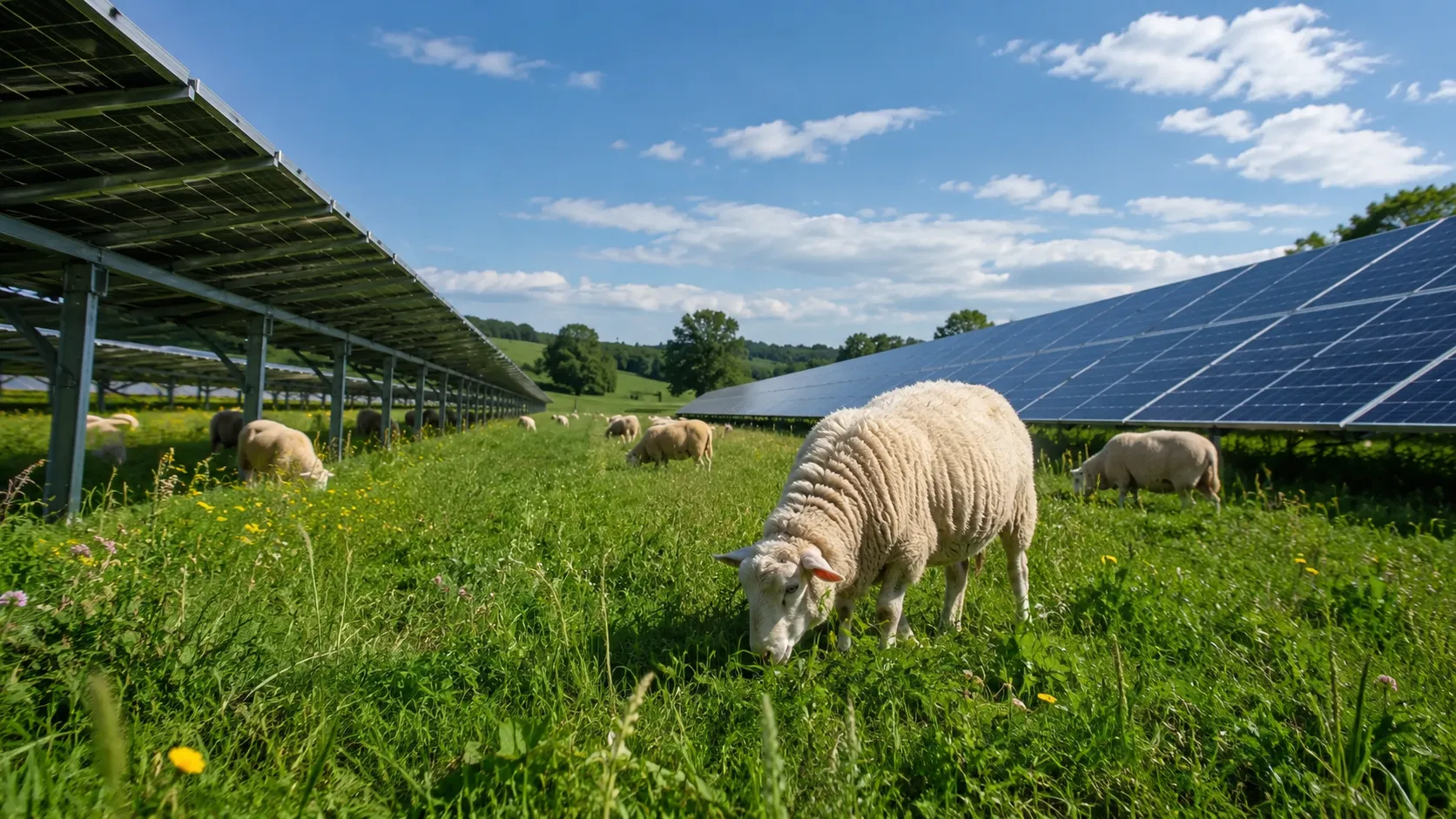
Across New South Wales, Victoria and Queensland, thousands of sheep are already grazing beneath utility-scale solar arrays. The land hasn't stopped being farmland. It's simply doing two jobs instead of one—producing food and generating electricity.
Solar grazing isn't a theory or a pilot project. Utility-scale solar farms across Australia are already integrating sheep into their day-to-day operations.
| Solar Farm | State | Livestock | Highlights |
|---|---|---|---|
| New England Solar Farm | NSW | ≈6,500 sheep | Rotating shade, improved pasture, frost protection. |
| Numurkah Solar Farm | VIC | ≈2,000 sheep | Natural vegetation control, no mowing, Agriculture Victoria research. |
| UQ Gatton and Warwick | QLD | Sheep grazing | Veterinary monitoring and protection from wild dogs using security fencing. |
| Parkes Solar Farm | NSW | 400 sheep | One of Australia's earliest commercial solar grazing trials. |
| Mugga Lane Solar Farm | ACT | Sheep grazing | Vegetation management and maintenance access. |
Across regional New South Wales, solar farms and sheep are proving they can share the same paddock. By grazing livestock beneath solar panels, landholders continue producing food while also generating renewable electricity—a practical approach known as solar grazing. See how agriculture and clean energy are working side by side.
Source:
NSW Climate and Energy Action - When sheep and solar work together
As more solar grazing projects have proven themselves, the debate has shifted. Rather than arguing that agriculture is being pushed aside, critics increasingly question whether the infrastructure itself harms livestock or permanently damages the land.
They're fair questions.
They're also questions that can be answered with evidence rather than Facebook memes.
If Solar Grazing Was a Problem, We'd Know By Now
Farmers don't need academics to tell them when livestock aren't thriving.
If sheep are stressed, they lose condition.
If pasture deteriorates, stocking rates fall.
If lambing percentages or wool production decline, somebody notices pretty quickly.
After years of commercial solar grazing across Australia, those warning signs simply haven't appeared.
Instead, research and practical experience are showing that well-managed solar farms can comfortably coexist with livestock production.
Stray Voltage Isn't Unique to Solar Farms
One concern that regularly appears is stray voltage.
It's a genuine electrical issue, but it's also been around for decades.
Faulty wiring, damaged equipment or poor earthing can allow small electrical currents to travel through infrastructure. Dairy farmers, in particular, have dealt with stray voltage around automated milking systems long before the first solar farm appeared.
Solar panels didn't invent the problem.
Modern farms are already full of electrical infrastructure—from electric fences and pumps to feeding systems and nearby transmission lines.
A 2021 study published in the Journal of Dairy Science examined livestock around solar panels, electromagnetic fields and transmission corridors and found no evidence that properly designed and maintained solar infrastructure caused abnormal behaviour or negative health outcomes.
Like every electrical installation, good engineering and regular maintenance are what matter.
Sheep Seem to Like the Shade
Anyone who's worked around livestock knows animals don't stand in full sun because they're making a point about renewable energy.
They stand in the shade.
Solar arrays create exactly that.
As tracking panels follow the sun throughout the day, they produce moving patches of shelter that sheep naturally use during the hottest parts of the afternoon.
The benefits don't stop there.
The shade slows evaporation, helping the soil retain moisture. Overnight dew collects on the panels before running down to the lower edge, creating narrow bands of additional moisture beneath the array.
Research compiled by the Clean Energy Council also shows pasture beneath solar panels often stays greener for longer and retains higher crude protein levels than pasture growing in full sun.
During extended dry periods, those small changes can make a noticeable difference to how long paddocks remain productive.
There's nothing mysterious about it.
It's simply a different microclimate.
The Toxic Run-off Story Doesn't Stack Up
Perhaps the most persistent claim online is that solar farms leak toxic chemicals into the surrounding land.
It sounds dramatic.
The obvious question is...
Where has it actually happened?
I once asked someone making exactly that claim to point me towards a documented Australian example where an operating solar farm had contaminated farmland through toxic run-off.
Instead of evidence, I got a meme.
That's the problem with many of these claims. They're repeated so often that people assume somebody, somewhere, must have proved them.
Yet documented examples remain remarkably absent.
If documented Australian cases existed, they'd be easy to find. That's exactly why I've included the search box below.
Try It Yourself
The claim that solar farms contaminate Australian farmland gets repeated all over social media.
I couldn't find a documented Australian example of an operating solar farm causing toxic contamination of surrounding farmland.
Don't take my word for it. Have a look yourself.
Search Google
Search terms: Australia solar farm contamination farmland
Modern commercial solar panels are sealed units designed to survive decades of exposure to Australia's weather. They're built primarily from glass, aluminium, silicon, copper and protective polymers. Yes, small amounts of metals such as lead and silver exist within the internal circuitry, but they're encapsulated inside the panel.
Environmental studies examining operating photovoltaic installations have found no evidence of significant soil or water contamination from intact panels during normal operation. The greater environmental challenges involving these materials occur during manufacturing and at end-of-life recycling—not while they're quietly generating electricity in the middle of a paddock.
Ironically, farms already contain plenty of equipment that presents similar or greater material risks if it's damaged or poorly maintained. Vehicle batteries, diesel tanks, hydraulic oil, treated timber and agricultural chemicals all require sensible management.
Solar farms are no different.
Good Farming Is Still Good Farming
None of this means solar farms magically manage livestock.
Sheep still need water.
They still need good pasture.
They still need parasite control, health checks and sensible stocking rates.
Commercial projects such as the New England Solar project near Uralla and the Numurkah Solar Farm in Victoria have demonstrated that sheep can thrive within these systems. Some operators have even reported modest improvements in wool production, while the shelter provided by the infrastructure has offered extra protection from frost and predators.
When problems occur, they're almost always management issues rather than technology issues.
Solar panels don't replace good farmers.
Keeping Some Perspective
One thing that's always fascinated me is where some people choose to set the environmental bar.
A paddock with rows of solar panels where sheep continue grazing is described by some as environmental destruction.
Yet compare that landscape with a coal mine.
One still produces grass, sheep and electricity from the same piece of land.
The other removes the landscape entirely while extraction is taking place, with rehabilitation only beginning after mining finishes.
They're not remotely the same thing.
The Debate Has Moved On
The old argument that solar farms permanently destroy productive farmland has largely been overtaken by what's actually happening on the ground.
Thousands of sheep are already grazing beneath operating solar arrays across regional Australia.
That doesn't mean every project is perfect. Like any farming enterprise, success depends on thoughtful planning, ongoing maintenance and good management.
But when the discussion is guided by evidence instead of assumptions, the picture becomes much clearer.
The evidence doesn't suggest solar farms are destroying Australian farmland.
If anything, they're proving the same paddock can grow grass, graze sheep and generate electricity—all at once.