The world has seen oil shocks before. Prices spike, markets panic, and eventually the system settles back into the familiar rhythm of the fossil fuel economy.
But the events unfolding in early 2026 feel different.
When the United States and Israel launched strikes against Iranian military and "nuclear facilities" on February 28, the geopolitical consequences were immediate. What followed was a shock to the global energy system that spread far beyond the Middle East.
Shipping through the Strait of Hormuz — one of the most critical energy chokepoints on Earth — slowed dramatically as insurers withdrew coverage and commercial vessels backed away from the region. Around a fifth of the world’s oil normally passes through this narrow waterway, so any disruption quickly sends ripples through global markets.
Oil prices jumped, shipping routes lengthened, and freight costs surged. Within days Australians were paying more at the petrol pump.
But the real story may not be the price spike itself. It’s what this moment reveals.
The global oil economy depends on a surprisingly fragile system: a handful of shipping routes, a few concentrated producing regions, and supply chains that stretch across oceans. When one of those links breaks, the effects are felt everywhere.
The Strait of Hormuz is the clearest example. Roughly 20 million barrels of oil move through it each day. When conflict disrupts the region, tankers are forced onto longer routes and supply tightens rapidly.
This time the disruption hasn’t come from a traditional naval blockade. Instead, the commercial infrastructure that keeps oil moving has started to unravel. War-risk insurance has been cancelled, vessels have been damaged, and shipping companies are simply avoiding the area.
The result is the same: tighter supply, rising costs and economies scrambling to adjust.
Australia’s Strange Energy Reality
For Australians, the consequences are particularly revealing.
Australia is one of the world’s largest exporters of energy. The country ships enormous quantities of coal and liquefied natural gas overseas. Yet the fuels that power Australian cars, trucks and aircraft largely come from somewhere else.
More than 90 percent of Australia’s petrol, diesel and aviation fuel is imported.
Most of it arrives from refineries in Singapore, which many assume provides a buffer from Middle Eastern instability. But those refineries rely heavily on crude oil shipped from the same region currently caught in conflict. When supply through the Strait of Hormuz tightens, the effect eventually reaches Australian ports.
Domestic refining capacity has also shrunk dramatically. Today only two refineries remain operating in the country, supplying a relatively small share of national fuel demand.
Australia’s strategic fuel reserves are also limited, sitting at roughly a month’s supply depending on fuel type — far below the 90-day stockholding expected of International Energy Agency members. (Well done Angus)
In other words, a country rich in energy resources remains deeply dependent on a supply chain that stretches halfway around the world.
When that chain is stressed, Australians feel it immediately.
Why This Moment Matters
Oil shocks have occurred many times before, but this one arrives at a very different point in history.
For most of the twentieth century there was no practical alternative to fossil fuels at scale. Even when supply crises occurred, the world had little choice but to absorb the shock.
Today the situation has changed dramatically.
Renewable energy technologies have matured, costs have fallen, and electrification is rapidly spreading across transport and industry. In Australia, solar, wind and energy storage already provide close to half of the electricity on the main grid.
Unlike fossil fuels, these resources do not rely on shipping lanes, pipelines or geopolitical stability. Sunlight and wind are local resources.
They cannot be blockaded.
They cannot be embargoed.
And they cannot be disrupted by conflicts thousands of kilometres away.
Every solar panel installed on an Australian roof and every wind turbine built in a regional energy zone reduces the nation’s exposure to global fossil fuel markets.
The Best EV Advertising Money Can’t Buy
Transport has long been the sector most dependent on oil, but even that is beginning to change.
Electric vehicles are moving from niche curiosity to mainstream reality. And rising fuel prices are accelerating that shift.
If the current crisis drags on, Australians may soon see a powerful demonstration playing out in everyday life.
One household is suddenly paying far more for petrol each week.
The neighbour next door, driving an electric vehicle, is barely affected.
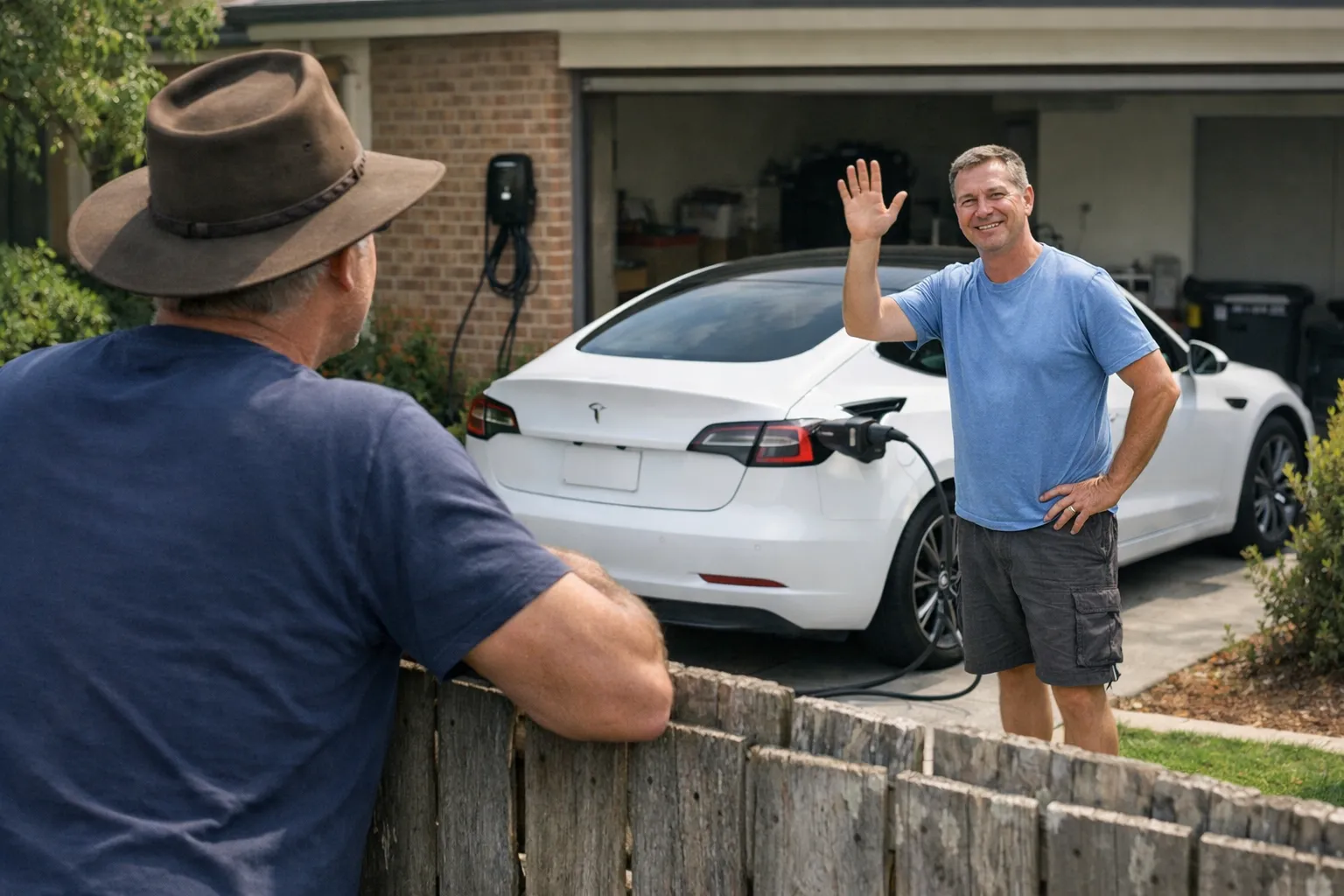
For years some people laughed at EVs, seeing them as impractical or weak alternatives to traditional cars. But imagine an ordinary Australian looking over the fence and seeing their mate next door happily driving around in an EV, going wherever they want without worrying about fuel prices.
No advertising campaign in the world can compete with that kind of real-world demonstration.
People notice.
People remember.
And eventually people start to think the obvious solution might be to stop relying on petrol altogether.
Pair an electric vehicle with rooftop solar and something remarkable happens: a household begins producing its own transport fuel.
Sunlight becomes kilometres driven.
That is a level of independence the oil economy simply cannot provide.
Rethinking Energy Security
For years opponents of renewable energy have argued that fossil fuels provide greater “energy security” because renewable power is supposedly unreliable.
But the events unfolding around the world raise an uncomfortable question for that argument.
Is the fossil fuel system actually secure?
The traditional electricity grid is built around large centralised power stations and long transmission lines. Disable a major plant or a key transmission corridor and millions of homes can lose power.
The oil system is even more concentrated. A handful of shipping routes and a few major producing regions supply much of the world.
Renewable energy systems look very different.
Rooftop solar, batteries, microgrids and local energy networks spread generation across thousands or even millions of locations. Instead of relying on a few massive facilities, power is produced everywhere.
This kind of system is inherently harder to disrupt.
Knocking out a single power plant can affect millions of homes. Knocking out a few rooftop solar systems barely makes a dent.
As conflicts overseas continue to disrupt traditional energy supply chains, many people may start recognising that decentralised energy systems are not just cleaner — they are also far more resilient.
The Crescendo of the Fossil Fuel Age
If you step back and look at the broader picture, the energy transition is already accelerating.
Solar and wind are now among the cheapest sources of electricity ever developed. Battery costs are falling rapidly. Electric vehicle adoption is climbing every year.
Entire industries are beginning to electrify.
None of this means fossil fuels will disappear overnight. Oil, gas and coal will remain part of the global energy system for some time.
But history rarely ends with a slow fade.
More often it reaches a point where economics, technology and geopolitics all start pushing in the same direction.
Moments like the 2026 energy shock may turn out to be part of that turning point.
A moment when the weaknesses of the fossil fuel system became impossible to ignore.
A moment when the alternatives finally looked not just cleaner, but smarter.
And perhaps, looking back decades from now, a moment that helped mark the beginning of the end of the oil age.